Animal architecture represents a diverse and sophisticated set of behaviours through which organisms shape their environments to meet essential biological needs. Although the term “architecture” is often associated with human construction, many animal species construct structures that rival against human engineering in complexity, efficiency, and ecological impact. These constructions—whether grown, woven, excavated, or collectively engineered—demonstrate how evolution produces functional design without conscious planning.
Across the natural world, animals face similar challenges: securing shelter, protecting offspring, accessing food, and avoiding predators. Yet species solve these problems through remarkably different architectural strategies. Bees build with geometric precision, termites construct climate‑regulated mounds, and birds weave intricate nests, and beavers reshape entire landscapes.
In each case, architecture becomes a visible for exploring behavioural evolution. It is not merely shelter but a structural manifestation of problem‑solving shaped by natural selection.
Sea anemones exemplify a form of architecture in which the organism’s body functions as both structure and tool. Its ring of tentacles forms a multifunctional living structure that captures prey, shelters symbiotic species, and channels food toward the mouth. These tentacles contain nematocysts, which are microscopic, harpoon‑like capsules that provide both defence and feeding capability.
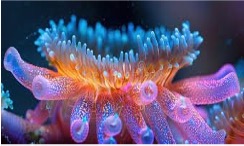
Sea Anemone
Many anemones incorporate external materials such as sand or shell fragments into their tissues, creating a form of natural armour. Their symbiotic relationship with photosynthetic algae further illustrates architectural adaptation: by orienting themselves toward sunlight, anemones optimise nutrient production. Some species reproduce through cloning, forming dense colonies of genetically identical individuals, and certain lineages exhibit negligible senescence (the absence of biological ageing). In these organisms, architecture is inseparable from physiology, demonstrating how structural innovation can emerge from the body itself.
Birds, construct external structures that are both temporary and highly specialised. Nest building begins with site selection, influenced by predation risk, climate, and resource availability. Birds gather materials such as twigs, grasses, leaves, mud, feathers, and moss, weaving or binding them. Because nests accumulate parasites over time, most species construct new ones each breeding season, refining their designs through usual behavioural patterns.
Avian nests vary widely in form and function. Cup nests, used by robins and sparrows, balance insulation with concealment. Eagles build large platform nests capable of supporting substantial weight and reused across years. Cavity nests exploit tree hollows for protection, while pendant nests—woven from fibres and spider silk—hang delicately from branches. Dome nests enclose eggs and chicks within protective chambers.
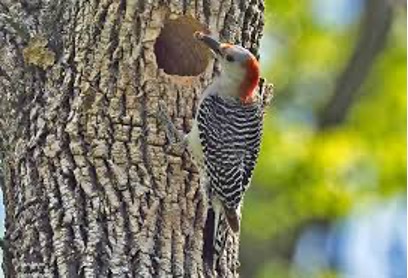
Cavity nest
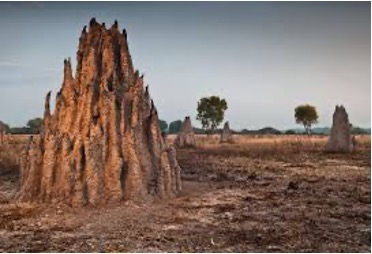
Termite mound
Termites construct some of the most complex structures relative to body size. Their mounds function as self‑regulating systems that maintain stable internal temperatures despite the extreme external temperature fluctuations. Workers mix soil with saliva to form a durable bio cement, and construction is coordinated through pheromone signalling, a process known as self‑organisation.
Within the mound, specialised chambers support distinct functions: nurseries for developing larvae, fungus gardens for cultivated food, ventilation networks that regulate airflow, and a central royal chamber housing the queen.
Beavers represent a form of architecture that extends beyond shelter to reshape entire ecosystems. By felling trees and constructing dams, beavers transform flowing rivers into stable ponds. These ponds provide safe access to underwater lodge entrances, protecting beaver families from predators. Beyond their immediate function, beaver constructions alter hydrology, create wetlands, increase biodiversity, and influence nutrient cycles.
Animal architecture reveals that building is not an exclusively human endeavour but a widespread evolutionary strategy. Whether grown, woven, or collectively engineered, animal structures illustrate the originality and ingenuity of natural selection and the diverse ways organisms shape their environments. Studying these constructions allows us to understand architecture as a biological phenomenon- one that emerges from instinct, ecological pressures, and evolutionary history. The natural world is full of builders, each contributing to the complexity of life through distinctive forms of design.
- Tara, Maeve, Ella