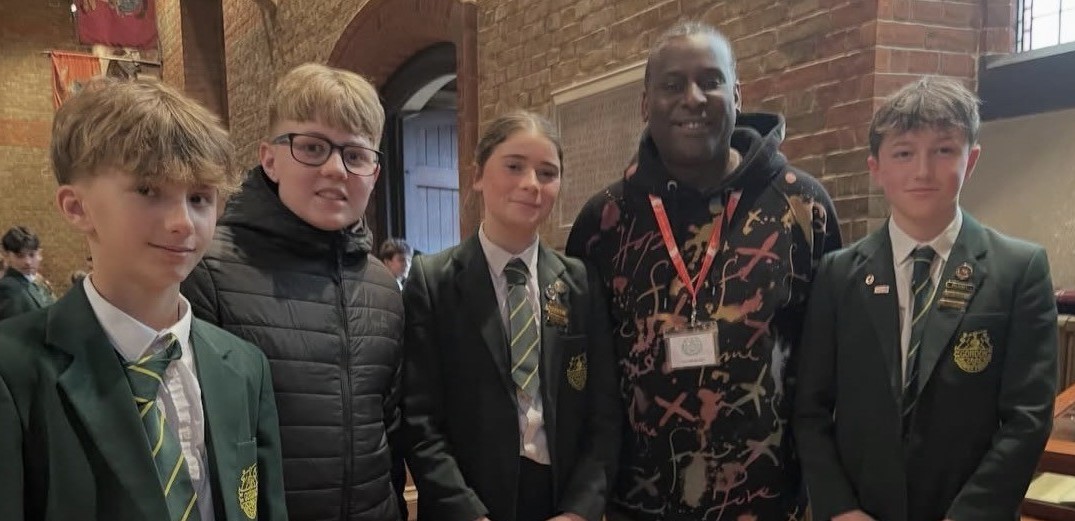

Dr Stuart Lawrence’s visit offered a powerful reminder of how personal history, hardship, and hope can shape a life dedicated to positive change. His family’s story begins long before his own childhood: his mother was born in Jamaica and moved to the UK at just fourteen, while his father travelled between the two countries before finally settling in Britain to secure better opportunities for their future children. The theme of opportunity runs through everything Dr Lawrence shares.
Throughout his talk, he drew on the wisdom of leaders and thinkers, including Nelson Mandela’s famous belief that “education is the most powerful weapon which you can use to change the world.” Dr Lawrence encouraged students to see themselves as authors of their own futures, reminding us that “you have the possibility to write your own life story.”
Despite being dyslexic and describing writing as his “worst nightmare,” he still became an author, creating his book, ‘Silence is not an option. You can impact the world for change.’ through voice recordings and editing tools, showing his dedication and determination to share something meaningful with the world. He dedicated it to his son, who reminds him of his late brother Stephen.
A central question guided his message: “Are you enough to change the world?” His answer is yes. Because whatever you want to do, you can. He introduced the idea of HOPE: Help One Person Every day, a simple but powerful philosophy that encourages small acts of kindness and connection.
Dr Lawrence has met influential figures such as Prince Harry, Meghan Markle, Prince William, and Princess Kate, yet he emphasised that true influence comes from character, not status. He shared the principle that life is 10% what happens to you and 90% how you react to it, especially when reflecting on the painful and inaccurate way newspapers portrayed his brother after his murder. Media outlets falsely linked Stephen to gangs and drugs—claims that were untrue and deeply upsetting for the family.
He also spoke about Stephen’s creativity. While working at McDonald’s, Stephen and his friends started a clothing label. They were described to have had quite a lot of attention and popularity from the brand, reaching some known celebrities. They had used aerosol cans for their artwork, which unfortunately led police to make unfair assumptions about graffiti and criminal behaviour. These experiences highlighted how stereotypes can distort the truth.


Dr Lawrence reminded students that mistakes are part of life, and growth comes from asking intuitive questions—especially “how” and “why.” His session was interactive, giving time for reflection, discussion, and exploring different mindsets. One of his favourite sayings is “Hard work beats talent when talent does not work hard,” a message he illustrated through stories of people who faced adversity but refused to give up, such as Sam Burns and Greta Thunberg. He also stressed that time is the most important resource we have.
Leading onto philosophy, he quoted Plato, who believed that understanding is the highest form of knowledge, and Aristotle, who argued that educating the mind without educating the heart is incomplete. Dr Lawrence left students with a powerful final idea: we are all revolutionaries, capable of shaping the world through our choices, actions, and compassion.
After the talk, a series of questions were put to Dr Lawrence to explore his role more deeply and understand his reasons for choosing to become such an influential figure:
Why did you choose to share your story with us today?
“Well, its world book day, so I thought it’s really important to show the younger generation the importance of reading and having a growth mindset and to stay positive.”
What do you want your talk to convey? What are the key messages of your talk?
“Hope and connection. And you can do anything if you put your mind to. It’s something that is not said enough – but it’s vital to know.”
Why do you choose to talk to young people instead of adults?
As Whitney Houston’s song, ‘Greatest love of all suggests, young people hold the power to shape a better tomorrow. Dr Lawrence explained that he wants to contribute to that future by helping children understand their potential and the impact they can have.
What changes do you think communities or schools can make to reduce violence?
“We should set up schemes in school where children can talk through their differences, where children can understand their own or others’ issues. Open conversation is essential, and that communities must provide ways for young people to discuss what is right, what is wrong, and how conflicts should be handled. Without these opportunities, misunderstandings grow, and hypocrisy can take root.”
- Olliyah
